Key facts
More than dry skin
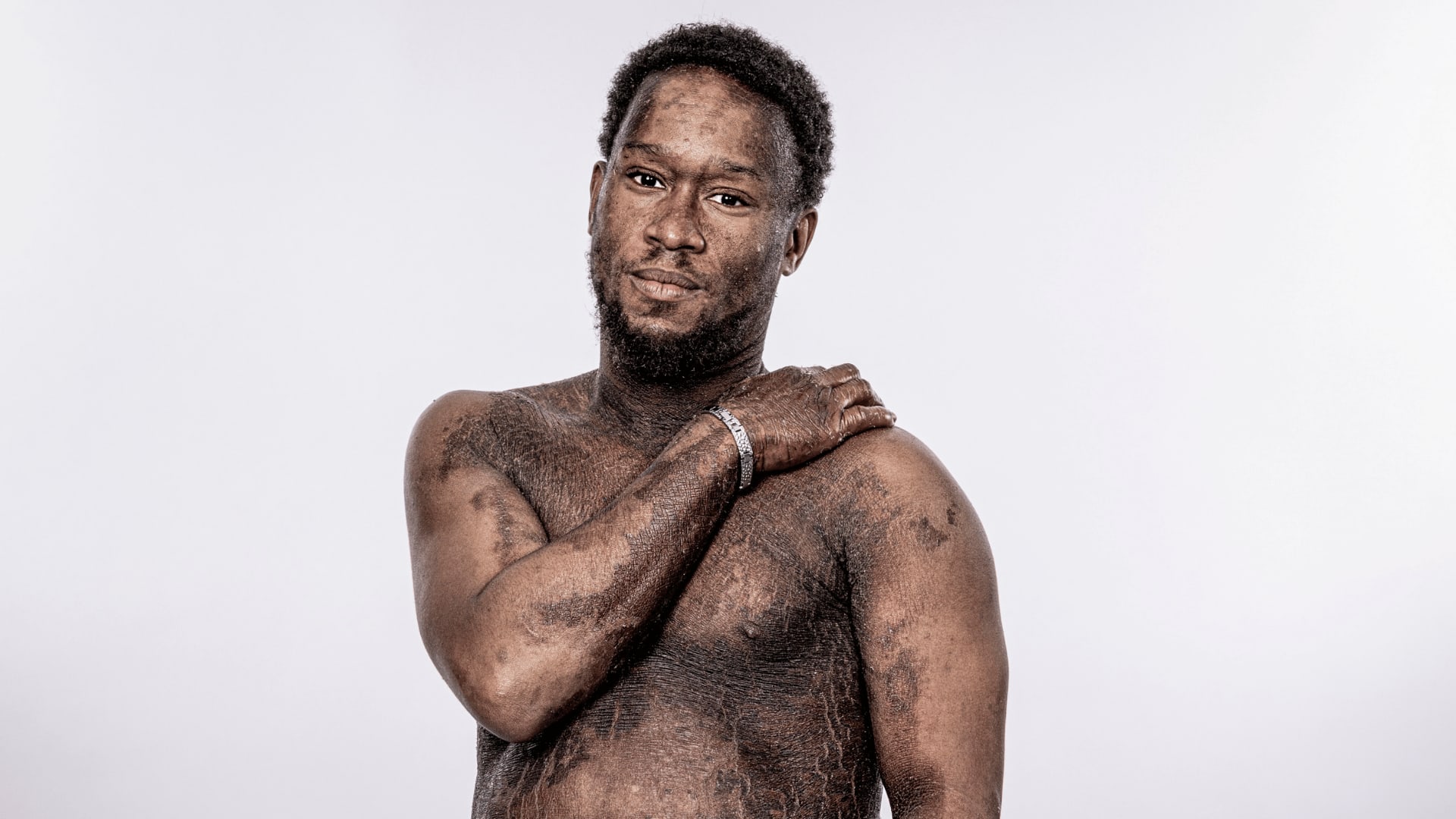
Lots of people have dry skin conditions, such as eczema or psoriasis, but they tend to be patchy and come and go. In ichthyosis the scaling is continuous and usually affects the whole body.
Most types are congenital, meaning they are present at birth, and inherited, meaning they come from changes in genes, so they may run in families.
What causes the scaling?
Skin is constantly shedding and being replaced, and genes control how this happens. In ichthyosis, changes in those genes mean skin cells don’t work properly.
In some types, cells are made faster than needed and pile up. In others, they can’t detach, so they build up in layers.
Can it be treated?
There is no cure at present, but symptoms can be managed, mainly through:
- regular, intensive moisturising, at least twice a day
- sometimes antiseptics or antibiotics
- occasionally retinoids, medicines that can reduce scaling
Types of ichthyosis, A to Z
Find your type, or the type your child has been diagnosed with. Each links to our full factsheet.
Showing all 13 conditions
A
Acquired ichthyosis
Usually appears in adulthood. Often comes from natural dryness of the skin in later life, and rarely is linked to another condition or a medicine.
ARCI
Autosomal recessive congenital ichthyoses
The family of conditions that includes lamellar ichthyosis, congenital ichthyosiform erythroderma (CIE) and harlequin ichthyosis.
B
Bullous ichthyosis
Also called epidermolytic ichthyosis (EI), BIE or EHK
Rare. From birth the skin is fragile, red and blisters easily. From early childhood it becomes thicker and scalier, and blistering eases.
C
Collodion baby
A description, not a diagnosis
Describes how some babies look at birth: covered in what parents describe as a tight, shiny film, like a sausage skin. It is usually linked to a type of ichthyosis.
Congenital ichthyosiform erythroderma (CIE)
Also called non-bullous ichthyosis
Very rare, about 1 in 300,000 births. Red skin with fine white scales. Most babies are born as collodion babies.
E
Erythrokeratoderma variabilis (EKV)
A very rare inherited skin disease, with around 50 affected families in the UK. Redness and thickened skin; 90% develop signs in their first year.
H
Harlequin ichthyosis
An extremely rare and severe inherited ichthyosis. Around five babies are born with it in the UK each year.
I
Ichthyosis vulgaris
New name: FLG-nEDD
The most common inherited type. Ranges from mild dryness to thick scaling, and often runs in families alongside eczema, asthma or hay fever.
L
Lamellar ichthyosis (LI)
Very rare, about 1 in 200,000 births. Babies are usually born with a collodion membrane, then develop large, dark, plate-like scales.
N
Netherton syndrome
New name: SPINK5-sEDD
A rare inherited condition. Very red skin with fine dry scales, often from birth or the first weeks. The skin barrier is “leaky”, losing heat and moisture.
P
Palmoplantar keratoderma (PPK)
Thickened skin on the palms of the hands and soles of the feet. It often runs in families, and everyone in a family has the same type.
R
Rare ichthyoses and syndromes
Including Sjögren-Larsson syndrome, Conradi-Hünermann syndrome, KID syndrome, Refsum disease and the trichothiodystrophies.
X
X-linked ichthyosis (XLI)
New name: STS-sEDD
The second most common type, affecting about 1 in 6,000 boys and men. Brownish scales that are often worse in winter.
No match. Try another spelling, or call us on 0800 368 9621 and we’ll help.
Living with ichthyosis
The inherited forms tend to last for life, though symptoms can get milder over time. If you have a child with ichthyosis, you may need to help them deal with other people’s reactions. Starting school and the teenage years can be especially hard.
As an adult, starting college, university, a new job or a new relationship can bring difficult times too. The ISG has leaflets for younger children, teenagers and young adults, and for teachers and others who care for your child.